Crossbuck
Marks the crossing and should be treated as a yield sign. Trains have the right of way.

Learn what signs and signals mean, how to avoid becoming trapped on the tracks, what to do during an emergency, and where to report a warning-device problem or recurring blocked crossing along the WNYP network.
Freight trains do not operate on a public timetable. A train can approach at any hour, on any track, and from either direction.
Highway users and pedestrians must yield because a train cannot steer away and may need a mile or more to stop.
Active devices warn of an approaching train. Passive signs identify the crossing and require the road user to look, listen, and yield.
Marks the crossing and should be treated as a yield sign. Trains have the right of way.
A train is approaching or occupying the crossing. Stop until the lights stop and the gates are fully raised.
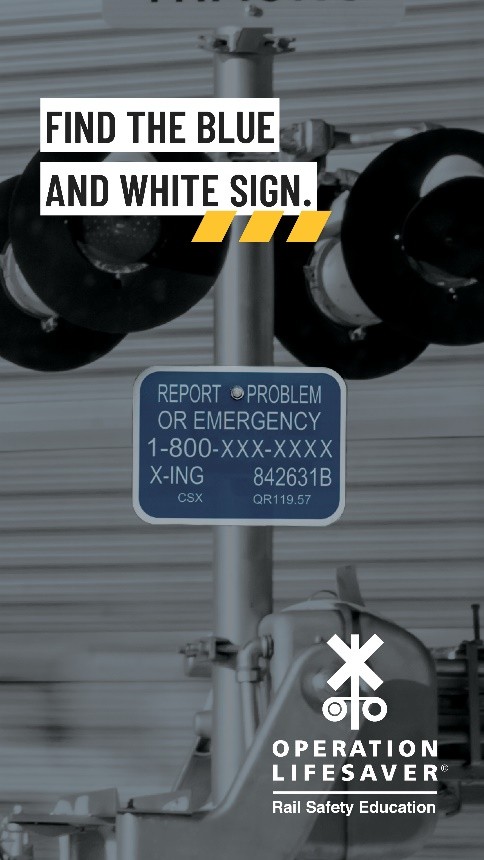
Lists the emergency telephone number and unique U.S. DOT crossing ID.
One train can hide another. Wait until you can clearly see in both directions.
Do not remain in the vehicle while trying to restart it. Evacuate everyone and move far away from the tracks.
These answers summarize public rail-safety guidance. Professional and regulated drivers must also follow applicable laws and employer procedures.
No. Freight trains can operate at any time, on any track, and in either direction. Always expect a train—even if the crossing is usually quiet.
A train has far more mass than a highway vehicle, and steel wheels have less friction on steel rail than rubber tires have on pavement. A freight train at highway speed may require a mile or more to stop.
Stay behind the marked stop line. When no stop line is present, Operation Lifesaver advises stopping at least 15 feet from the nearest rail. Regulated vehicles may have additional requirements.
Flashing red lights warn that a train is approaching or occupying the crossing. Stop and wait until the lights stop flashing and it is clearly safe to cross.
No. Never drive around, under, or between lowered gates. Remain stopped until the gates are fully raised, the lights stop flashing, and the crossing is clearly safe.
Continue moving and clear the crossing. Do not stop, reverse, or remain on the tracks.
Another train may be approaching on a second track, or operating conditions may continue to activate the system. Wait until the lights stop and the gates are fully raised.
A passive crossing has no flashing lights or gates. It may have a crossbuck, yield sign, stop sign, pavement markings, or advance warning signs. Slow down, look, listen, and be prepared to stop.
A crossbuck marks the crossing and should be treated as a yield sign. Trains have the right of way.
Get everyone out immediately and move far away from the tracks. Call the railroad using the blue-and-white ENS sign and provide the U.S. DOT crossing number. Call 911 for injury, fire, immediate danger, or when no ENS sign is available.
The ENS sign lists the railroad emergency telephone number and the crossing's unique U.S. DOT identification number.
Use it for a vehicle or object on the tracks, a warning-device malfunction, a collision, damaged equipment, or another urgent safety problem at that crossing.
Remain clear and do not assume the crossing is safe. Call the number on the ENS sign and provide the crossing ID. Call 911 for immediate danger or injury.
Do not enter unless there is enough room on the far side for your entire vehicle to clear every track. If it will not fit, do not commit.
Plan the route in advance and watch for low-ground-clearance warning signs. Raised crossings can trap lowboys, trailers, buses, RVs, and some passenger vehicles.
Yes. School buses, certain hazardous-material vehicles, passenger vehicles, and other regulated equipment may be required to stop and follow specific procedures.
Avoid shifting while on the crossing. Select a gear that lets the vehicle cross completely without stopping or changing gears.
No. Tracks, bridges, tunnels, yards, and equipment are private property and active operating areas. Cross only at a designated public crossing.
Use only designated public crossings. Obey gates, lights, signs, and pavement markings, and remain alert for flangeway gaps, multiple tracks, and trains from either direction.
No public access is implied. Photograph only from a lawful public location and review WNYP's Visitor & Photography Policy before planning a visit.
A quiet zone restricts routine horn sounding through a federal process. It does not mean trains are absent or that horns will never sound; engineers may still sound the horn for safety.
Use the FRA Public Blocked Crossing Incident Reporter for a recent recurring or extended blockage. It is not for active emergencies.
Use the blue-and-white ENS sign or the FRA Rail Crossing Locator. Each public crossing has a unique U.S. DOT crossing number.
Yes. Operation Lifesaver provides free rail-safety presentations for many audiences, subject to volunteer availability.
Commercial vehicles, buses, farm equipment, trailers, RVs, and hazardous-material movements may require additional planning and specific procedures.
Enter only when the entire vehicle can clear every track.
Use an alternate route when raised-crossing clearance is uncertain.
Cross without shifting, stopping, or rolling backward.
Regulated vehicles must follow applicable legal and employer procedures.
A general website contact form should never be the first action during an active crossing emergency.
Move to safety and call 911. When possible, also call the railroad using the ENS sign.
Call 911 →Call the emergency number on the ENS sign and provide the crossing ID.
Learn About ENS Signs ↗Use the FRA Public Blocked Crossing Incident Reporter. It is not for emergencies.
Open FRA Reporter ↗Contact WNYP for non-emergency crossing questions, planned work, contractor coordination, or community rail-safety education. Do not use the general contact form for an active emergency.