
Railroad Emergency Information
An emergency near the tracks? Act immediately.
Move people away from danger, call 911 for a life-threatening situation, and use the blue-and-white Emergency Notification System sign at a public crossing to contact the railroad responsible for that location.
If a vehicle is stuck on the tracks, get everyone out and away immediately—even when no train is visible. Then safely locate the crossing's blue-and-white ENS sign and call the number printed on it.
Vehicle Stuck on the Tracks
Get out. Get away. Make the call.
Do not remain inside the vehicle while trying to restart or move it. Trains can approach at any time and cannot stop quickly.
Get out immediately
Evacuate every passenger. Leave personal belongings behind and do not delay while attempting to restart or move the vehicle.
Move far away
Move everyone well away from the tracks and the vehicle. Remain alert for trains on any track and in either direction.
Use the ENS sign
Call the phone number on the blue-and-white sign and provide the crossing ID. If no sign is visible, or anyone is injured or in immediate danger, call 911.
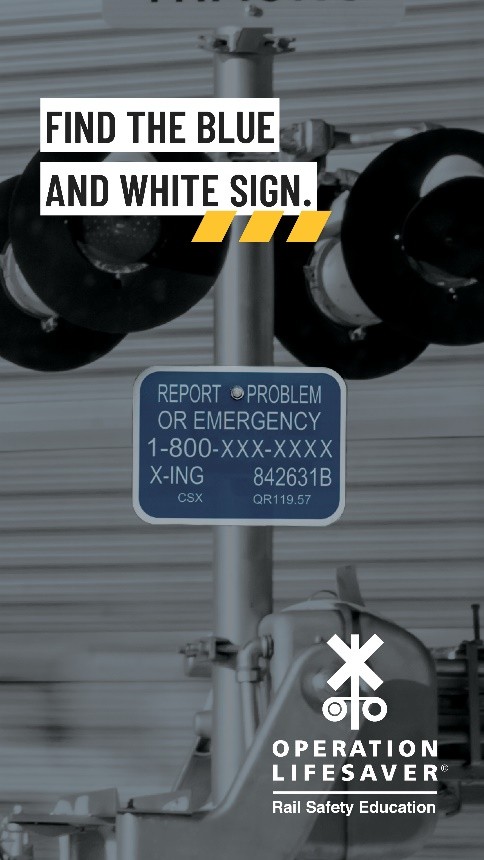
Graphic courtesy of Operation Lifesaver, Inc. · Rail Safety Education
Emergency Notification System
Find the blue-and-white sign at the crossing.
Emergency Notification System—or ENS—signs are posted at or near public highway-rail crossings. They provide a direct emergency telephone number for the railroad responsible for the crossing and the unique U.S. DOT crossing number.
Use the sign to report a vehicle, object, person, damaged crossing device, or other urgent problem on or near the tracks. Give the dispatcher the crossing ID exactly as it appears on the sign.
What Should Be Reported?
Use the crossing sign or 911 whenever safety is at risk.
Do not enter railroad property or approach equipment, damaged infrastructure, spilled material, or a person on the tracks.
Vehicle or equipment on the tracks
Get everyone away, call the ENS number, provide the crossing ID, and call 911 when there is immediate danger or injury.
Crossing signal or gate problem
Safely report damaged, malfunctioning, or continuously activated warning devices using the ENS sign at the crossing.
Person, animal, or obstruction
Do not attempt a rescue on railroad property. Call 911 and the railroad using the ENS information when available.
Fire, spill, collision, or derailment
Move to a safe location, call 911, avoid smoke or spilled material, and follow instructions from emergency responders.
Help Responders Find the Scene
Accurate location information can save critical time.
Railroad locations can be difficult to describe. Use the crossing sign and nearby landmarks to provide the clearest location possible.
Crossing ID
Read the U.S. DOT crossing number from the blue-and-white ENS sign.
Road & community
Provide the road name, municipality, county, nearest intersection, and useful landmarks.
What happened
Describe the vehicle, obstruction, signal problem, injury, fire, collision, spill, or other hazard.
People & materials
Report known injuries, passengers, vehicles, smoke, leaks, placards, or spilled material without approaching.
First Responders & Dispatch Centers
Do not assume train movements have stopped.
Tracks remain active until the responsible railroad confirms that train traffic has been stopped or protected. Locate the blue-and-white ENS sign and communicate its telephone number and crossing ID through the incident command or dispatch center.
Operation Lifesaver provides railroad-specific safety resources and training for law enforcement, firefighters, dispatchers, and other emergency personnel.
On-Scene Priorities
Employees & Contractors
Follow your railroad-specific procedures.
This public page does not replace job briefings, operating rules, emergency plans, contractor orientation, supervisor instructions, or internal notification and incident-reporting requirements. In an emergency, protect life first and call 911 when required. Employees and authorized contractors must also notify the appropriate railroad supervisor, dispatcher, or project contact and complete required internal reporting under their applicable procedures.
Safety & Access Resources
Additional information for the public, contractors, and communities.
Railroad Safety
Public safety, crossing awareness, employee readiness, access expectations, and WNYP's overall safety approach.
Visitor & Photography Policy
Review authorization, escort requirements, private-property restrictions, and photography expectations.
Driving Safely Near Tracks
Crossing-safety guidance, ENS information, stalled-vehicle procedures, and resources for drivers.
Emergency Responder Resources
Railroad-specific guidance and resources for law enforcement, firefighters, dispatch centers, and emergency personnel.
Frequently Asked Questions
Answers covering railroad property, customer service, freight, safety, railcars, storage, and other common topics.
Contact WNYP
Contact the railroad regarding a non-emergency safety concern, planned access, contractor coordination, or community question.
Non-Emergency Questions
Need safety information or help planning work near the railroad?
Contact WNYP for non-emergency safety questions, contractor coordination, community education, or planned work near railroad property. Do not use the general contact form for an active emergency.